Simultaneous length and angle measurement
with the SP 5000 TR triple beam laser interferometer - precision redefined

Challenges: thermal influences
Solution: Triple-beam laser interferometer
How the SP 5000 TR works
Optimal alignment of the laser interferometer
Compensation of environmental factors
Precise measuring room monitoring
Case studies on the SP 5000 TR
Webinar: displacement and angle measurement
Precision is a decisive factor in modern industry and research.
In many high-tech industries such as mechanical engineering, semiconductor manufacturing and optics, the requirements for measurement uncertainty and process control are becoming increasingly demanding. Progressive miniaturization and the need to manufacture components of all sizes with the highest precision require state-of-the-art measurement technology. However, many conventional measuring systems cannot keep pace with these developments.
"A pure length measurement WITHOUT simultaneous angle measurement is no longer state of the art.
If tilts are not correctly recorded during the measurement, this leads to measurement errors.I am convinced that the dynamic and synchronous recording of length, yaw and pitch angle values offers considerable added value.
If all measured values are recorded quickly, environmental influences are also minimized."Dr. Denis Dontsov, Managing Director, SIOS Meßtechnik GmbH

The Challenges
Thermal influences in laser interferometric length and angle measurement
In industrial and scientific applications, measuring equipment rarely consists of a single material.
Granite, stainless steel, titanium, invar, aluminum, ceramic and glass are the materials that are very often found in various combinations and compositions in a measuring setup. These have different linear expansion coefficients and thermal conductivities. They react to temperature changes with different time constants.
However, users often only know the general measuring room class or the average temperature stability over 24 hours. Short-term temperature fluctuations or the day-night behavior of a measuring room are often not taken into account, which leads to unexpected measurement deviations.
If length and angle measurements are carried out at different times, temperature changes can significantly distort the results. This makes it difficult to reliably analyze all measurement data.
Conclusion: A fast and simultaneous acquisition of several degrees of freedom enables a coherent analysis of measurement deviations. As a result, the influences of temperature fluctuations on various measured variables can be reduced as these are measured simultaneously.
The Solution
What is the advantage of simultaneous length and angle measurement?
To meet these challenges, our development team has developed the SP 5000 TR triple-beam laser interferometer. It measures lengths, pitch, and yaw angles* simultaneously, well correlated and consistent.
The high level of data synchronization enables dynamic measurements that minimize drift effects and speed up measurement processes. In addition, the external triggering allows the measured values to be recorded “on the fly” at object speeds of up to 3 m/s.
As space is often a limiting resource in measuring environments, the SP 5000 TR has been designed to be particularly compact. The fiber optic coupling of the laser interferometer ensures maximum precision in a space-saving design.
If measured values are to be offset against each other, the achievable resolution plays a decisive role.
For example, a length measurement with a target measurement uncertainty of 10 nm and an Abbe offset of 100 mm requires an angular resolution of at least 0.1 µrad.
The SP 5000 TR fulfills these requirements and enables high-precision measurements in various application areas.
*optionally, rolling angles can also be measured with the RAS 175 accessory
No loss of time due to delayed measurements
Simultaneous recording of length and angle ensures a consistent data basis and reduces measurement errors.
Minimized thermal influences
Fast data acquisition and high synchronicity enable precise correction of drift effects.
Space-saving integration
The compact design and fiber optic coupling enable use even in confined production environments.
Highest resolution for reliable results
Extremely fine angular resolution and minimal measurement uncertainty guarantee precise measurement results even in demanding applications.
How the triple-beam laser interferometer works
Like all SIOS laser interferometers, the functional principle of the interference-optical measuring system is based on the application of the Michelsons interferometer principle.
The SP 5000 TR triple-beam laser interferometer combines three interferometers in one device. The same highly stable long-term laser frequency stability of 2-10-8 of the He-Ne laser is used in all three measuring channels. This means that three length values can be measured simultaneously with nanometer accuracy. The corresponding angle can be determined with high precision from the difference between two length values and the calibrated beam distance, enabling the simultaneous measurement of position, pitch, and yaw. In this way, high-precision simultaneous path and angle measurements are possible.
Roll angle measurement can be integrated through the optional use of the RAS 175 W roll angle measurement sensors.
The laser interferometer has a displacement measuring range of 5 meters and an angular measuring range of ± 12.5° with a reflector. The angular resolution is up to 0.01 µrad under stable environmental conditions. With the standard triple-beam interferometer, the beam distance between the three laser beams is 12 mm. Due to the simultaneous and highly synchronous acquisition of measured values, the results are not distorted even at high object speeds of up to 3 m/s.
Further technical information can be found in the data sheet.
The interferometer system has a modular design and can therefore be adapted to a wide variety of measurement tasks.
The fiber optic coupling of the sensor head and the integrated beam direction detection support easy handling and precise adjustment.
The design of the SP 5000 TR triple-beam laser interferometer is compact and robust. This makes it ideal for high-precision measurements in industry and research.
OEM versions, also for use in a vacuum, are available on request.
Alignment of the laser interferometer system
How can the SP 5000 TR be optimally adjusted for precise measurements?

An adjustment joint is used as standard to adjust the direction of the measuring beams. It makes it easy to align the measuring beams parallel to the guidance or measuring direction.
Thanks to the optical alignment aids integrated in the interferometer sensor, the correct alignment of the measurement setup can be carried out quickly and easily using the graphical software interface of the SIOS Signal Monitor.
In this way, alignment-related measurement errors can be minimized.
Compensation of environmental factors
How does the SP 5000 TR compensate for environmental influences during measurement?
To ensure that the high-precision length and angle measurements are not adversely affected by heat input, the stabilized He-Ne laser used as the light source is placed outside the sensor at an uncritical distance. As the laser beam reaches the sensor head via a fiber optic cable, it only contains optical components that determine its functionality but do not cause any heat. The interferometer sensor and the cables are also fully protected, particularly with regard to industrial applications. This means that the robust triple-beam interferometers can withstand even potentially dirty operating environments.
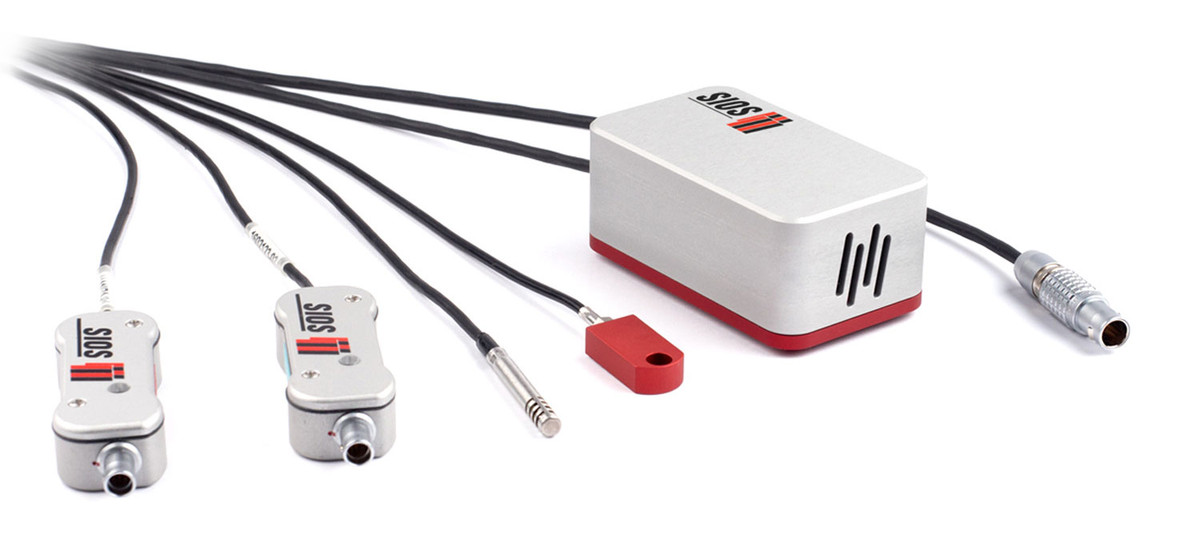
The measurement result is strongly influenced by fluctuating environmental factors such as air temperature, air pressure or humidity. With the help of wired or wireless measuring sensors and probes, the environmental variables are recorded and the measurement result corrected accordingly. This achieves a very high level of measurement accuracy.
Precise measuring room monitoring for reliable measurement results
Why is it so important to monitor the environmental parameters in the measuring range?

Especially in industrial environments, measurements are not always carried out under ideal laboratory conditions or in optimized measuring rooms.
However, monitoring the ambient conditions is of crucial importance.
SIOS offers you the equipment and software for seamless monitoring of your measuring room environment.
LCS-Temp – Mobile set for all-round monitoring of measuring rooms
The LCS-Temp standard set contains eight temperature sensors with factory test certificate in a
practical transport case, four tripods and the LCS-Desk software extension.
More information on monitoring environmental parameters in the measuring environment can be found under the menu item: Environmental measurement technology.
Case Studies
Practical applications of the triple-beam laser interferometer

Precise length measurement poses a particular challenge if the measuring reflector cannot be positioned in alignment with the axis of movement. This offset leads to the so-called Abbe error, which can significantly affect the measurement uncertainty.
The illustration shows that it is generally not geometrically possible to place the measuring axis of the interferometer directly in the drive axis of the guide to be measured. The distance between the drive axis and the measuring axis in conjunction with the tilt of the reflector therefore leads to a measurement deviation that can be very large under certain circumstances and often remains unknown.
With the SP 5000 TR triple-beam laser interferometer, it is possible to mathematically compensate for the Abbe error.
The triple-beam technology enables the simultaneous acquisition of length and angle values with maximum precision. As a result, the measurement deviations caused by the Abbe offset can be massively reduced.

In addition to the Abbe error, the second geometric error that occurs during measurement is the alignment error. This is length-dependent and is specified as a relative value µm/m. At the same time, however, it is difficult to recognize, especially with short measuring distances.
The calculation examples listed in the table show which errors can occur with a purely visual alignment of a laser beam. If the beam on the measuring mirror shifts by 0.5 mm from the beginning to the end of the measuring distance, this results in an error of 0.5 µm/m at a distance of 500 mm (example 1). If the same displacement is observed at 50 mm, the error is linearly greater and very high at 50 µm/m (example 2).
The SP 5000 TR triple-beam laser interferometer offers a user-friendly solution for the alignment error, as the system has an integrated alignment aid that facilitates fine adjustment of the laser beam. A target cross in the software conveniently indicates whether the target has been hit perpendicularly, making this error influence negligible.

Measurements in dynamic applications often require lightweight measuring equipment so that these movements are not influenced by their own weight. This applies in particular to fast, complex movements such as those that occur in research and industrial production.
In combination with the specially developed lightweight reflector, the SP 5000 TR triple-beam laser interferometer offers a tailor-made solution for these requirements. The lightweight reflector minimizes mass inertia and therefore enables fast and precise measurements even with highly dynamic movements.
Possible applications
Highly dynamic applications
The SP 5000 TR can measure precise angle changes of up to 3 m/s even with fast movements.
Large angle measuring ranges
With a measuring range of ±12.5°, the system offers the flexibility to fully capture even complex motion sequences.
Sub-microrad resolution
A resolution of 0.01 µrad ensures extremely fine detection of the smallest angle changes.
Lightweight construction
Weighing only 25 g, the lightweight reflector has hardly any influence on the measurement setup.

Optical quality surfaces with poor reflective properties that tilt pose a particular challenge for precise measurements.
The SP 5000 TR triple-beam laser interferometer in combination with a lens attachment offers a precise and reliable solution. The lens attachment enables measurement on surfaces such as aluminum and ensures reliable angle measurement, even with fast movements.
Possible applications
Highly dynamic movements
The lens attachment enables precise measurements even with fast tilting movements of optical surfaces with poor reflection properties.
Sub-microrad resolution
With a resolution of 0.01 µrad, even the smallest changes in angle can be detected.
Optimum beam guidance
The lens attachment ensures ideal focusing and reflection of the laser beam, minimizing measurement errors.

Laser interferometers that work according to the differential principle are used when particularly high demands are placed on the stability of measured values over long periods of time. The measuring and reference beams are arranged in such a way that the distance between them is minimized.
The SP 5000 DI/TR laser interferometer as a differential version of the three-beam interferometer is the right choice for this.
Possible applications
Highly stable measuring arrangements
The influence of the dead distance of the measurement is completely eliminated by the differential principle, as is the movement of the sensor relative to the measurement setup.
Long-term stability
The system offers maximum measurement stability, even for measurements that have to be carried out over hours or days.

Measurements in a vacuum place special demands on the materials used and on cleanliness in the manufacture of the sensors. The design must be such that air inclusions in the sensor head are avoided and low outgassing of the materials is achieved.
Another problem is the handling of the sensor when it is inserted into the vacuum chamber. For this reason, solutions have been developed that allow the sensor to be separated from the feedthrough during servicing, thus minimizing the installation effort.
The specially adapted SP 5000 TR triple-beam laser interferometer for vacuum applications up to 1 × 10⁻⁷ mbar with all specific requirements can be assembled on request.
Possible applications
Vacuum-optimized materials
The aluminum, stainless steel or Invar design ensures stability and reliability in a vacuum.
Highest precision
By measuring in a vacuum, the ambient influences on the measurement are eliminated, which currently represents the limit of the minimum achievable measurement uncertainty.

Precise and fast acceptance measurements are essential in the modern production of linear axes. Especially with high cycle times, measurements must be performed dynamically, simultaneously and with maximum precision in order to capture all relevant degrees of freedom of an axis.
The SP 5000 TR triple-beam laser interferometer in combination with the InfasAXIS software offers an optimum solution for this. This system enables the simultaneous acquisition of all relevant parameters of a linear axis in real time.
Possible applications:
Simultaneous measurements
Detection of all relevant degrees of freedom for the position in the axis direction.
High cycle times
Optimized for fast production cycles with measuring speeds of up to 3 m/s
Standard-compliant measurements
The InfasAXIS certificates in accordance with the DIN ISO 230-1 standard guarantee the highest quality of acceptance measurements.

With fiber optic-coupled sensors, the measurement setup can be complicated by geometric conditions. The SP 5000 TR has a wide range of additional equipment, such as for reducing the beam distances for very small measurement objects or the beam deflector attachments. This means that even hard-to-reach areas can be reached without the need for a complex, special design.
On request, the SP 5000 TR triple-beam laser interferometer can be specially adapted for any location in order to provide the optimum solution for a wide range of measuring tasks.
Possible applications:
Measurements under restricted access conditions
The deflection optics allow precise alignment of the laser beam, even if the measuring location is spatially limited or difficult to reach.
Compensation of offset errors
The combination of length and angle measurement reliably corrects the Abbe error.
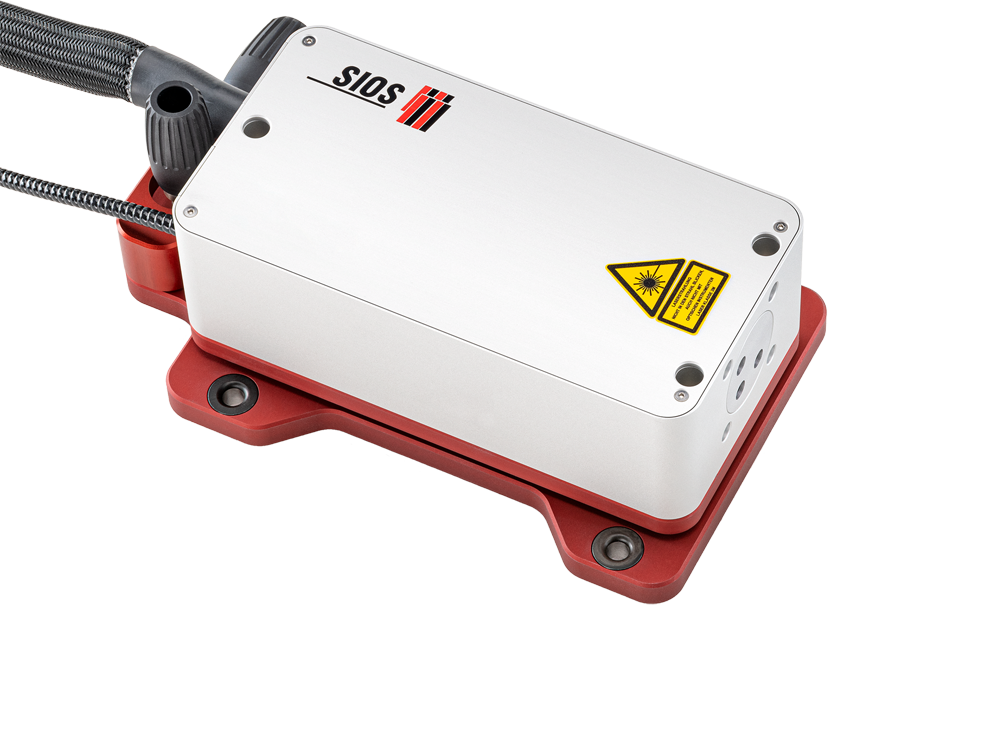
Further information on the interferometer system
Detailed information on the SP 5000 TR triple-beam laser interferometer such as technical data sheet, technical articles, dimensional sketches, CAD data, accessories and software can be found on the product detail page.
For which applications is the measuring system suitable?
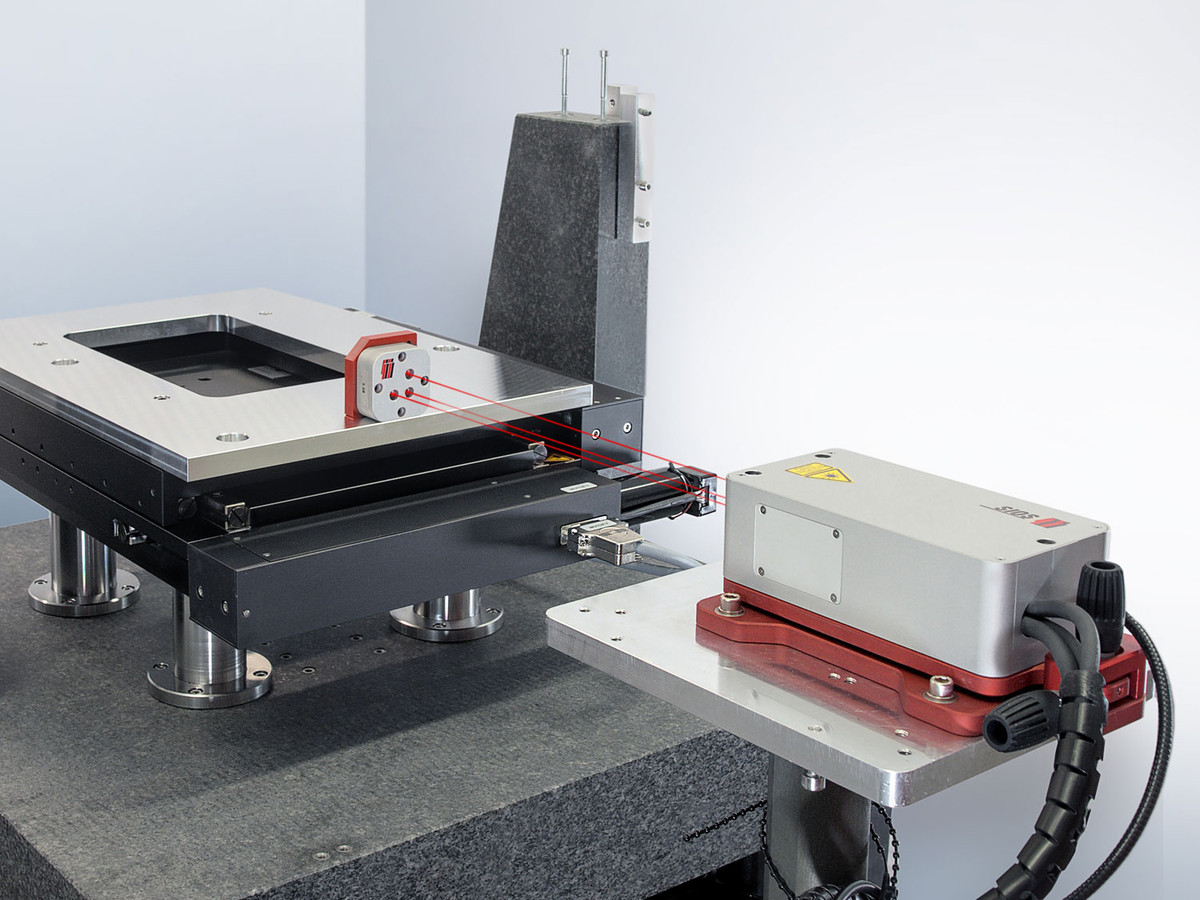
Typical areas of application for the SP 5000 TR
Characterization of linear axis systems and linear tables
Analysis and compensation of guide errors
Calibration of machine axes
Validation of positioning systems and axis modules
Research and development in the fields of mechanical engineering, nanopositioning, and precision technology

Our webinar tip:
High-precision simultaneous displacement and angle measurement
SIOS experts provide insights into the theory and practice of length and angle metrology. You will learn, among other things, which factors have an influence on measurement uncertainties, how to realize an Abbe error-free measurement setup or how to compensate Abbe errors.
Are you interested in simultaneous, precise length and angle measurement?
We will be happy to advise you on how to best integrate the SP 5000 TR into your application - whether in the test lab, in production, or in research. Just give us a call or use the form below. We will get back to you as soon as possible.

Fields marked with an * are required for processing.